How to Declutter When You Have Too Much Stuff: A Calm, Realistic Way to Begin Without Overwhelm
A steady, pressure-free approach to decluttering when your home feels full and traditional advice hasn’t helped.
If you’re trying to figure out how to declutter when you have too much stuff, it usually doesn’t feel like a neutral question. It feels loaded. Heavy. A little embarrassing, maybe.
Most people don’t arrive here because they love organizing. They arrive because their space has slowly stopped supporting them, and they don’t know where to start without making things worse.
This isn’t about doing a big purge or proving anything to yourself. It’s about understanding why “too much” feels so paralyzing, and how to approach it in a way that doesn’t ask more energy than you actually have.
You don’t need momentum yet. You don’t need a system.
You just need a place to stand that doesn’t add pressure.
When “Too Much Stuff” Isn’t Just About Volume
When people say they have too much stuff, they’re rarely talking about a specific number of items. They’re talking about how the space feels to live in.
Too much usually means the room asks things of you all day long. It asks you to decide. It asks you to remember. It asks you to manage unfinished intentions.
The problem isn’t that your home is full. It’s that nothing in it feels settled.
This is why traditional decluttering advice often misses the mark. It treats volume as the issue, when the real strain is cognitive. Every surface becomes a reminder of something you haven’t resolved yet.
That unresolved feeling creates a quiet background stress. You may not notice it constantly, but it drains energy in small, steady ways. By the time you think about decluttering, you’re already tired.
Understanding this matters, because it changes how you approach the process. If the fatigue came from decision overload, the solution can’t start with more decisions. If the stress came from constant visual demand, the solution can’t be an all-at-once overhaul.
Before anything leaves your house, something else has to happen first. The pressure has to come down.
Why Traditional Decluttering Advice Backfires Here
Most decluttering advice assumes you’re starting from a place of surplus energy. It assumes you can make hundreds of clear decisions in a row without friction.
When you already feel buried by your belongings, that assumption quietly works against you.
Rules like “touch every item once” or “decide immediately” sound efficient, but they compress emotional, practical, and identity-based choices into a single moment. That’s a lot to ask from someone who already feels overwhelmed by their space.
This is where people often stall or quit. Not because they don’t care, but because the process demands more clarity than they can access on command.
Another issue is the emphasis on dramatic change. Big results are framed as motivating, but for many people they increase fear instead. The larger the imagined outcome, the higher the stakes feel.
When the stakes feel high, the nervous system resists. You may procrastinate, overthink, or avoid the space entirely. That avoidance then becomes another layer of shame, even though nothing has actually gone wrong.
If decluttering hasn’t worked for you before, it’s not a personal failure. It’s a mismatch between the method and your current capacity.
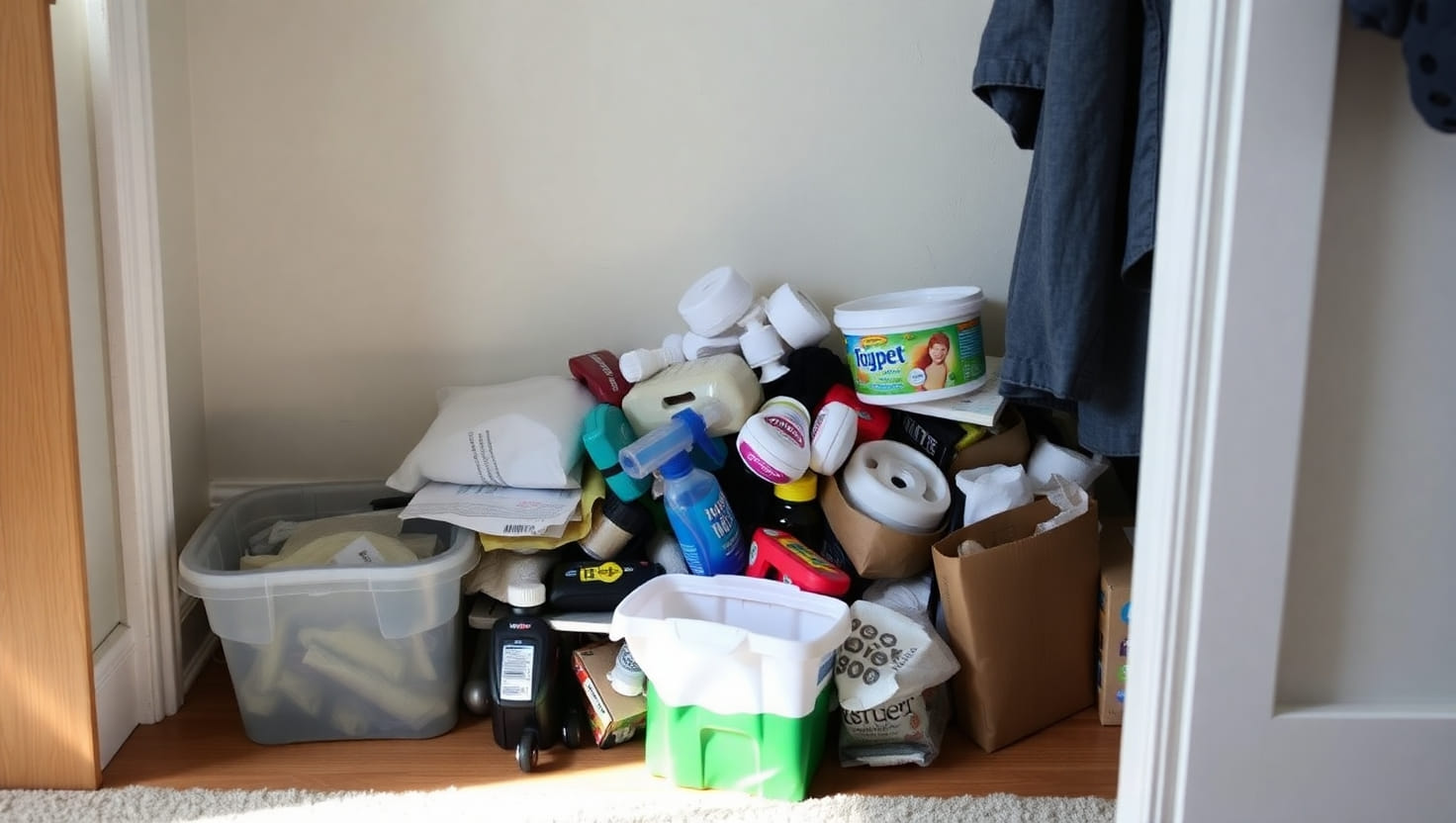
The starting point has to match where you are, not where you’re told you should be.
The Real First Step: Reducing Pressure, Not Belongings
When you have too much stuff, the most helpful first step isn’t getting rid of anything. It’s making the situation feel less urgent.
Urgency narrows thinking. It pushes you toward extreme choices or total avoidance. Neither creates lasting change.
Reducing pressure looks quieter than action-based advice, but it’s what allows action to happen later without force. This might mean giving yourself permission to stop aiming for “decluttered” and instead aim for “less activated.”
Activated spaces are the ones that constantly pull at your attention. They’re loud, visually and mentally. A calmer approach begins by noticing which areas create the most internal noise, not which ones look the messiest.
This isn’t about ranking rooms or making a plan. It’s about noticing your own response.
Where do you feel a small drop in your chest when you walk by? Where do you avoid looking directly?
Those reactions tell you more than any checklist could.
By shifting your focus from outcomes to internal signals, you start working with your capacity instead of against it. That alignment is what keeps the process from collapsing later.
Nothing needs to be decided yet. You’re just changing how you’re relating to the space.
Separating Identity From Objects You’ve Accumulated
One reason decluttering feels so heavy when you have a lot of stuff is that accumulation often happened during meaningful seasons of life. Busy years. Hopeful plans. Survival periods.
Objects quietly absorb those contexts.
When advice frames decluttering as “keeping only what you love,” it can trigger an identity question you weren’t prepared to answer. What if you don’t know who you are right now? What if your life has changed faster than your home has?
This is where people get stuck, surrounded by things that reflect past versions of themselves. Letting go can feel like erasing proof that those versions mattered.
A gentler approach is to separate appreciation from obligation. An object can represent something important without needing to stay physically present. Keeping everything as evidence often creates the opposite effect—it buries meaning under volume.
You don’t need to decide who you are today in order to declutter. You only need to notice which items require you to be someone you’re no longer able or willing to be.
That awareness softens the decision-making later. It turns decluttering into a process of alignment rather than loss.
Why Small, Unfinished Areas Matter More Than Big Wins
When you’re overwhelmed by how much you own, it’s tempting to wait for a large block of time or a burst of motivation. That waiting can last years.
What often creates movement instead is finishing something small enough that it fully resolves. Not halfway. Not temporarily.
Unfinished areas carry more weight than large cluttered ones because they represent suspended effort. A box you started sorting months ago quietly drains more energy than a full closet you’ve never touched.

Completion brings relief, even when the area is tiny.
This doesn’t mean racing to finish things. It means choosing spaces where “done” is actually possible without negotiation. A single drawer. One surface. One container.
When something is fully resolved, your brain stops tracking it. That freed attention is what makes the next step feel lighter, not harder.
Big wins are visible. Small completions are stabilizing.
If you’re learning how to declutter when you have too much stuff, this distinction matters. Stability comes first. Momentum grows out of that, not the other way around.
The goal at this stage isn’t progress. It’s relief you can feel immediately, without recovery time.
Letting Go of the Idea That You Have to Start Everywhere
When you have too much stuff, one of the quiet pressures is the sense that wherever you start will be wrong. Start in the kitchen and you’re avoiding the closet. Start small and it feels like you’re not taking it seriously.
That pressure creates paralysis.
Decluttering doesn’t require a fair or comprehensive starting point. It requires a tolerable one. The best place to begin is wherever your nervous system doesn’t spike the moment you think about it.
This is usually not the most cluttered area. It’s the area that feels emotionally neutral enough to engage with without bracing yourself.
There’s a belief that meaningful change has to start with the hardest thing. In practice, that belief delays change indefinitely. When the bar is set at “do the worst first,” the mind looks for escape.
Starting somewhere manageable isn’t avoidance. It’s regulation.
You’re teaching your brain that interacting with your stuff doesn’t automatically lead to exhaustion or regret. That lesson matters more than what you actually declutter in the beginning.
Once that association softens, other areas become less intimidating. Not because they’ve changed, but because you have.
How Visual Clutter Triggers Decision Fatigue All Day Long
A home with too much stuff doesn’t just look full. It behaves like an open loop. Every visible item is a tiny, unanswered question.
Do I need this? Where does this go? Why is this still here?
Your brain doesn’t consciously ask these questions every time, but it registers them. Over hours and days, that adds up to fatigue that has nothing to do with physical mess.
This is why you can feel exhausted in your own home without having done anything.
When decluttering advice focuses only on storage or sorting, it misses this dynamic. The issue isn’t that things are out. It’s that they’re unresolved.
Reducing visual demand is often more impactful than reducing volume. A space can still contain many items and feel calm if those items feel intentional and complete.
This is also why hiding clutter temporarily can bring relief, even if nothing was decided. The relief isn’t fake. It’s your nervous system responding to fewer inputs.
Understanding this helps you approach decluttering with more compassion. You’re not lazy or dramatic for feeling overwhelmed. Your environment is asking for constant attention.
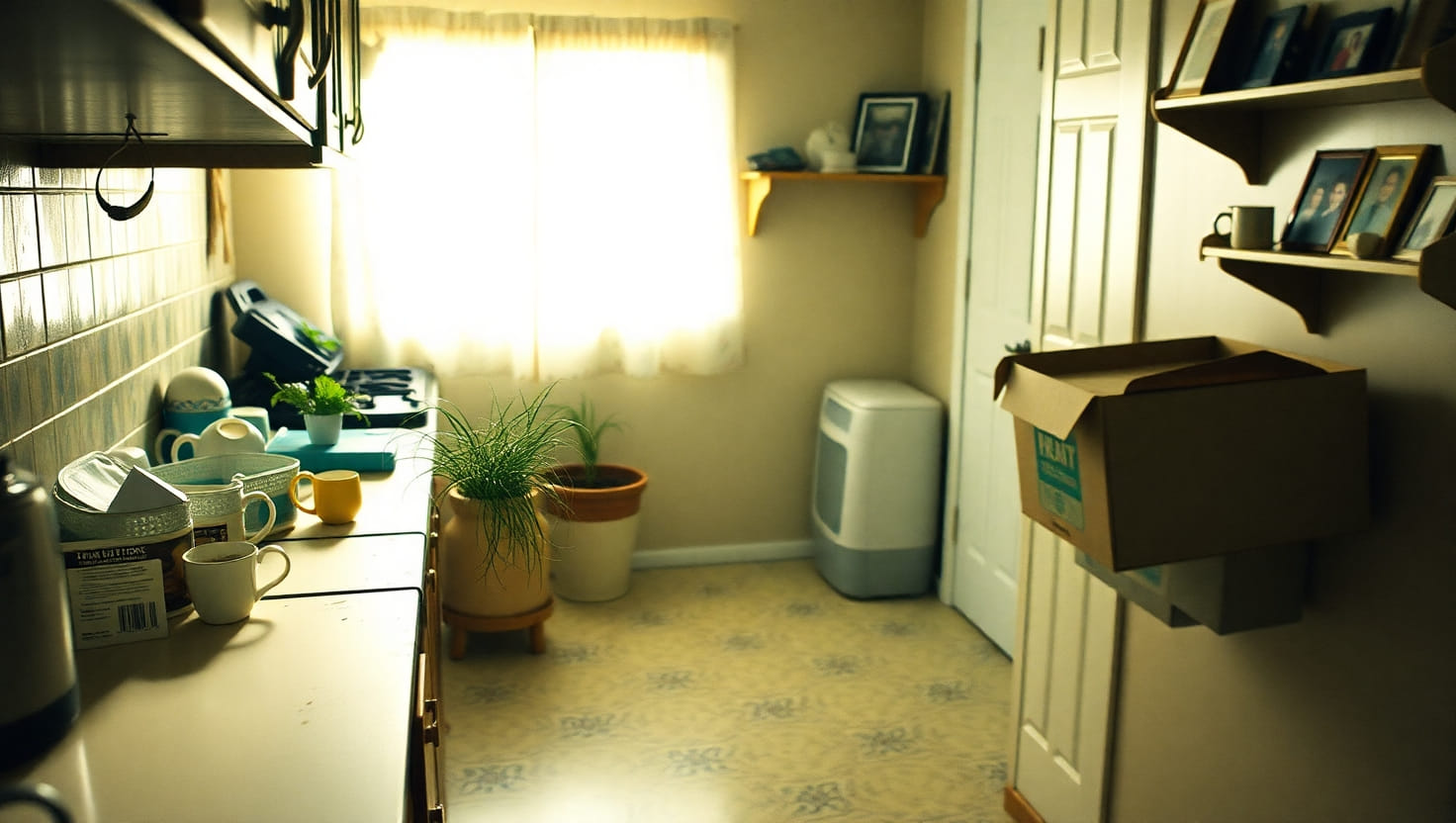
The work is about lowering those asks, one small pocket at a time.
Why Sorting Can Be More Draining Than Discarding
Sorting is often presented as the responsible first step. In reality, it can be the most draining part of the process when you already have too much.
Sorting asks you to evaluate everything without giving you the relief of resolution. Items move from one pile to another, but nothing actually settles.
This keeps your brain in decision mode without payoff.
Discarding, on the other hand, creates immediate closure. Even one clear removal reduces the total field of attention. That’s why throwing away obvious trash can feel surprisingly emotional—it’s the first moment of quiet.
This doesn’t mean you should force yourself to get rid of things you’re unsure about. It means recognizing that endless categorizing can stall progress and increase fatigue.
If you notice yourself sorting the same items repeatedly, that’s a sign the process is costing more energy than it’s giving back.
A gentler rhythm alternates between clarity and rest. Clear what’s clear. Pause before what isn’t. Let decisions ripen instead of demanding them all at once.
Decluttering sticks better when your energy increases slightly after a session, not when it drops to zero.
Making Space Without Deciding What Stays Forever
One of the heaviest assumptions around decluttering is that every decision is permanent. That belief raises the stakes of each choice, especially when you have a lot of stuff tied to different life chapters.
You’re not required to decide what stays forever in order to make space now.
Temporary decisions can still create real relief. Moving items out of active living areas, even into another room or container, reduces daily friction. The space benefits immediately, without forcing emotional closure before you’re ready.
This approach often brings clarity over time. Once an item is no longer part of your daily environment, its importance becomes easier to assess. Absence can be more informative than constant presence.
This isn’t avoidance. It’s pacing.
By allowing decisions to be provisional, you protect yourself from regret-driven hoarding and from forced purging. You’re creating breathing room for discernment instead of demanding certainty upfront.
When the pressure of permanence lifts, many decisions resolve themselves quietly.
How to Work With Limited Energy Instead of Waiting for Motivation
Motivation is unreliable when you’re already overloaded. Waiting to feel ready often means waiting indefinitely.
Energy, on the other hand, can be worked with.
Most people have small, uneven pockets of capacity. Ten minutes between tasks. A brief window of mental clarity. A moment when avoidance loosens its grip.
Decluttering that respects these pockets looks different from advice built around long sessions. It doesn’t aim for immersion. It aims for compatibility.
Doing less than you could is often the right choice. Stopping while you still feel okay builds trust with yourself. That trust is what makes it easier to return.

When you consistently end sessions before depletion, your brain stops associating decluttering with punishment. Over time, resistance lowers.
This is especially important when you’re learning how to declutter when you have too much stuff. The quantity isn’t the main obstacle. The mismatch between effort and recovery is.
A process that leaves you intact is one you can repeat.
When Decluttering Brings Up Guilt Instead of Relief
For many people, the hardest part of decluttering isn’t choosing what to keep. It’s managing the guilt that surfaces when they consider letting something go.
Guilt often comes from stories attached to objects. Money spent. Gifts received. Good intentions that didn’t turn into habits. These stories create a sense of obligation that lingers long after the object has stopped serving you.
When you have too much stuff, guilt can stack. Each item feels small on its own, but together they create a constant emotional undertow. That undertow makes decluttering feel morally charged, even when it doesn’t need to be.
It helps to notice that guilt is rarely about the item itself. It’s about a fear of being wasteful, ungrateful, or careless. Those fears say more about your values than about your behavior.
Letting go doesn’t erase the care or effort that once existed. The money was already spent. The gift was already received. The intention already mattered.
Decluttering becomes gentler when you stop asking whether you deserve to keep or discard something. A quieter question is more useful: does this still need to be managed by me?
Releasing responsibility is different from rejecting meaning. When guilt softens, decisions lose their sharp edges.
How Containers Can Clarify Limits Without Forcing Decisions
When everything feels important, nothing feels manageable. This is where physical limits can quietly help without requiring constant judgment.
Containers create boundaries that objects alone don’t. A shelf, a drawer, a bin—these define how much space something is allowed to take up. The limit exists whether you feel decisive or not.
Instead of asking how much you should keep, you let the container answer that for you.
This approach removes the need to evaluate every item in isolation. You’re not deciding the worth of each object. You’re choosing a reasonable amount of space and seeing what fits comfortably within it.
What doesn’t fit becomes information, not failure.
This is especially helpful when you have collections, hobbies, or categories that grew during a different season of life. The container acknowledges that these things still matter, while gently acknowledging that they can’t expand indefinitely.
There’s no urgency here. You can adjust the container later if needed. The purpose isn’t to lock in a final decision. It’s to replace endless mental negotiation with a visible, neutral boundary.
Clarity often emerges once the limits are clear.
The Difference Between Clearing Space and Creating Order
Clearing space and creating order sound similar, but they place very different demands on your energy.
Clearing space is subtractive. It asks what can leave, what no longer needs attention, what can be resolved enough to move out of the way.

Creating order is additive. It introduces systems, labels, and placement decisions. It asks you to imagine future use and consistency.
When you have too much stuff, trying to create order too early can feel exhausting. Systems built on top of unresolved volume tend to collapse, which reinforces the belief that decluttering “doesn’t work” for you.
Clearing space first lowers the complexity of everything that comes after. Fewer items mean fewer decisions about where things belong. Order becomes simpler because the field is smaller.
This doesn’t mean you should live in chaos until everything is perfect. It means recognizing which phase you’re actually in.
If your space feels loud and crowded, subtracting will bring more relief than organizing. If it feels sparse but scattered, gentle structure may help.
Confusing these phases leads to frustration. Respecting them creates steadier progress, without forcing your energy to stretch beyond what’s available.
Why Progress Feels Invisible When You Live With Your Stuff
One reason decluttering can feel discouraging is that you’re inside the environment every day. Small changes blend into the background quickly.
You remember how cluttered it still feels, not how much quieter it used to be.
This doesn’t mean nothing is happening. It means your baseline is shifting gradually, which is exactly how sustainable change tends to work.
When you live with your stuff, progress is measured in fewer interruptions, not dramatic reveals. You might notice you can find things faster. Or that one room doesn’t spike your stress anymore. These changes are subtle, but they matter.
The mind often discounts slow improvements because they don’t create a clear before-and-after contrast. That can make you feel stuck even when you’re not.
It helps to notice what no longer happens. Less searching. Less shuffling piles. Less mental noise when you walk into a room.
Decluttering when you have too much stuff is less about transformation and more about quiet subtraction. The absence of strain is the signal, even if it doesn’t announce itself loudly.
Letting the Process Change as Your Life Does
A common fear is that if you don’t finish decluttering quickly, you’ll be stuck doing it forever. That fear pushes people toward rigid plans that don’t adapt well to real life.
Life changes. Energy changes. Needs shift.
A decluttering approach that can flex with those changes is more valuable than one that promises completion on a timeline.
What worked during one season may not work during another. That doesn’t mean you’re backsliding. It means the context has changed.
Instead of aiming for a fixed endpoint, it can help to see decluttering as an ongoing relationship with your space. Sometimes that relationship is active. Sometimes it’s quiet.
This perspective removes the pressure to “get it right” once and for all. It allows you to pause without losing ground.
When the process is allowed to evolve, it becomes supportive instead of demanding. And support is what makes it possible to return, even after breaks.
You’re not failing if the work stretches out. You’re responding to your actual life, as it is now.
When Decluttering Finally Starts to Hold
At a certain point, the question shifts. It’s no longer “Where do I start?” but “Why does this keep slipping away from me?”
That moment usually comes after you’ve tried being gentle. After you’ve slowed down. After you’ve proven to yourself that pressure isn’t the answer.
What’s left isn’t more effort. It’s understanding what makes decluttering stick in real life, alongside fatigue, changing seasons, and uneven energy.
For many people, that clarity doesn’t arrive all at once. It forms when the process starts to feel livable instead of aspirational.
That’s often where the deeper shift begins.