How to Declutter Your House Without Burning Out or Starting Over Again
A calm, realistic approach to decluttering your house that respects your energy, time, and emotional load.
Decluttering your house often sounds like a project that requires momentum, motivation, and a clear weekend. For many people, that framing alone is enough to create resistance. This guide takes a different approach. It’s not about fixing everything or reaching a finished state. It’s about understanding how clutter forms, why it lingers, and how to work with your real life instead of against it. There’s no expectation to move fast here. You can read, pause, and return whenever it suits you.
Start by redefining what decluttering actually means in your life
Before anything changes in your house, it helps to quietly reconsider what decluttering means to you. Many people carry an inherited definition that equates decluttering with minimalism, rigid systems, or dramatic before-and-after results. That version can feel intimidating, especially if your home has been accumulating layers for years.
In a more sustainable sense, decluttering is simply the act of reducing friction in your daily environment. It’s not about having less for the sake of less. It’s about noticing which objects make it harder to move, think, rest, or complete ordinary tasks. When you view decluttering through this lens, the work becomes less about discipline and more about relief.
This shift matters because it removes the pressure to make perfect decisions. You’re not deciding what kind of person you should be. You’re observing what supports you now. Items that were once useful or meaningful can still be acknowledged without needing to stay in your immediate space.
Decluttering also doesn’t have to be consistent across your whole house. Different rooms serve different roles, and your tolerance for visual noise may vary from one space to another. Allowing for that variation creates a more honest starting point.
When the goal becomes ease rather than completion, decluttering stops feeling like a test. It becomes a gradual adjustment, guided by your lived experience instead of an external standard.
Notice where clutter costs you energy before deciding what to remove
A common mistake in decluttering is starting with categories or quantities instead of impact. It’s easy to ask how much you own, but it’s often more useful to ask where your energy is being quietly drained. Clutter tends to be most disruptive in areas that interrupt daily rhythms, even if those areas don’t look especially messy.
Think about the moments when you feel subtle irritation or fatigue at home. It might be searching for a utensil, navigating a crowded entryway, or clearing a surface before you can use it. These small interruptions accumulate, and they’re often more telling than the overall appearance of a room.
By focusing on energy cost, you avoid decluttering spaces that aren’t currently a problem. A packed bookshelf that doesn’t interfere with your day may not need attention right now. A lightly cluttered counter that stops you from cooking comfortably might.
This approach also reduces decision fatigue. Instead of evaluating every object, you’re responding to specific points of friction. That narrows your focus and makes choices feel more grounded. You’re not asking whether an item is objectively worth keeping. You’re noticing whether it earns its place in that particular spot.
As you move through your house with this awareness, patterns often emerge. Certain types of items tend to gather where decisions are postponed. Seeing those patterns can be more helpful than immediately trying to correct them.
Decluttering guided by energy is quieter, but it’s also more durable. It aligns your space with how you actually live.
Separate emotional weight from practical usefulness
Many homes hold items that are difficult to part with not because they’re useful, but because they’re emotionally charged. Gifts, inherited belongings, and remnants of past phases often carry meaning that isn’t easily articulated. Traditional decluttering advice can unintentionally make this harder by framing emotional attachment as something to overcome.
A gentler approach is to separate emotional weight from practical usefulness without forcing a decision right away. An item can matter to you and still not need to live in your everyday space. Recognizing that distinction creates room to breathe.
It can help to notice what role the item is currently playing. Some objects actively support memory or identity. Others simply signal obligation or unfinished processing. Treating these categories the same leads to unnecessary strain.
You’re allowed to create temporary holding spaces for emotionally complex items. This isn’t avoidance; it’s pacing. Emotional clarity often comes later, once the pressure to decide has eased. Giving yourself permission to delay can make eventual choices feel more respectful.
It’s also worth remembering that meaning doesn’t disappear when an object leaves your house. Memories are not stored in physical items alone. For some people, documenting or photographing certain belongings can preserve what matters without requiring permanent storage.
Decluttering becomes less fraught when it stops being about proving detachment. It becomes an act of care, both for your space and for your past selves.
Work with your available capacity instead of waiting for motivation
Many people postpone decluttering because they’re waiting to feel motivated, rested, or inspired. In reality, motivation often follows action, not the other way around. More importantly, your available capacity fluctuates, and expecting it to be consistent can stall progress indefinitely.
A more realistic approach is to work with the energy you already have on an ordinary day. That might mean making very small adjustments rather than tackling full projects. Decluttering doesn’t require intensity to be effective. It requires repetition that doesn’t overwhelm you.
This might look like clearing one drawer instead of a whole room, or returning a few misplaced items when you notice them. These actions may seem insignificant, but they gradually reduce background stress. Over time, your home begins to feel more responsive to you.
It’s also useful to let go of the idea that decluttering must be done in uninterrupted blocks. Short, irregular moments count. They often integrate better into real life than planned sessions that get postponed.
When you align decluttering with your actual capacity, you avoid the cycle of starting strong and stopping abruptly. There’s less self-judgment and more continuity. The work becomes something you can return to, rather than something you have to restart.

Progress that respects your limits tends to last longer, even if it’s quieter.
Allow each room to have a different decluttering standard
One reason decluttering feels overwhelming is the assumption that the entire house must follow the same rules. In practice, rooms serve different functions and support different levels of activity. Expecting uniformity can create unnecessary pressure.
A kitchen, for example, benefits from clarity and accessibility. Items are used frequently, and clutter quickly interferes with function. A bedroom might prioritize calm and visual softness. A storage area may simply need to be navigable, not minimal.
Giving each room permission to have its own standard reduces all-or-nothing thinking. You’re not failing if one space feels settled and another feels unresolved. They may be in different phases for valid reasons.
This flexibility also makes it easier to maintain progress. When a room’s setup matches how it’s used, it requires less ongoing effort to keep it functional. You’re not constantly correcting it to meet an abstract ideal.
It can help to think of decluttering as creating appropriate environments rather than perfect ones. What does this room need in order to support what happens here? That question naturally leads to more tailored decisions.
When you stop forcing consistency, your house becomes more cooperative. Each space does its job, and the overall load feels lighter without requiring constant attention.
Let go of the idea that decluttering has a right order
A lot of decluttering advice insists on starting in a specific place. Closets first. Or paperwork. Or the smallest room. While structure can be helpful, it can also create unnecessary friction if it doesn’t match how your mind works. When you feel stuck before you begin, the problem is often the prescribed order, not your willingness.
Decluttering doesn’t have a universally correct sequence. What matters more is where you can enter the process with the least resistance. For some people, that’s an area they barely care about. For others, it’s the space that causes daily annoyance. Both are valid starting points.
Allowing yourself to choose your own entry point builds trust with the process. You’re not forcing yourself into a plan that feels misaligned. You’re responding to what feels most accessible right now. That sense of choice lowers internal pushback.
It’s also worth knowing that momentum doesn’t require linear progress. You can move between rooms, pause for long stretches, or revisit the same area multiple times. Decluttering is rarely a straight path. It’s more often a spiral, where understanding deepens gradually.
When you release the pressure to do things “in order,” you make it easier to begin at all. Starting somewhere imperfect but tolerable is usually more effective than waiting for the ideal plan to appear.
Treat surfaces as signals, not failures
Visible clutter on surfaces often triggers the most discomfort. Counters, tables, and floors are where clutter feels loudest, and many people interpret this as a personal shortcoming. In reality, surfaces are simply where unresolved decisions land.

Instead of treating cluttered surfaces as a problem to correct, it can help to see them as information. They tell you which items don’t have clear homes, which routines are overloaded, or where transitions in your day are breaking down.
Clearing a surface without addressing why it collects clutter usually leads to repetition. The items return because the underlying conditions haven’t changed. Observing patterns first allows for more sustainable adjustments.
You might notice, for example, that papers pile up near the door because there’s no place to process them when you come in. Or that kitchen counters fill because storage is inconvenient for frequently used items. These insights are more useful than simply tidying.
Working with surfaces gently also reduces shame. You’re not scolding yourself for mess. You’re learning how your space responds to your habits. That perspective makes decluttering feel collaborative rather than corrective.
When surfaces start to clear as a byproduct of better flow, the change tends to hold with less effort.
Reduce duplicates that quietly complicate your days
Duplicate items are easy to overlook because each one seems harmless on its own. A few extra pens, multiple water bottles, several versions of the same tool. Over time, though, duplicates can complicate storage and decision-making more than you realize.
The issue isn’t abundance. It’s diffusion. When similar items are spread across different locations, it becomes harder to find what you need and easier to buy replacements unnecessarily. This creates subtle stress that often goes unnoticed.
Decluttering duplicates doesn’t require counting everything you own. It can start with noticing moments of confusion or excess choice. If you open a drawer and have to sort through several versions of the same thing, that’s a signal.
It can help to gather like items briefly and see them together. This isn’t about forcing yourself to keep the smallest number possible. It’s about identifying which ones you naturally reach for and which ones linger without purpose.
Letting go of duplicates can be emotionally easier than other decluttering decisions because the function remains covered. You’re not depriving yourself. You’re simplifying access.
As duplicates decrease, storage becomes more intuitive, and everyday tasks require less mental effort.
Make storage serve retrieval, not just containment
Many homes are full of storage solutions that technically hold items but don’t make them easy to use. Boxes, bins, and drawers can hide clutter without reducing it if retrieval feels cumbersome. Over time, this disconnect leads to overfilling and avoidance.
Effective storage supports quick understanding. You should be able to tell what’s inside without unpacking the container or relying on memory. When storage requires too much effort to navigate, items tend to migrate back to visible surfaces.
Decluttering and storage work best together when the goal is accessibility. That might mean fewer containers, more open storage, or simply placing items closer to where they’re used. Convenience matters more than aesthetics here.
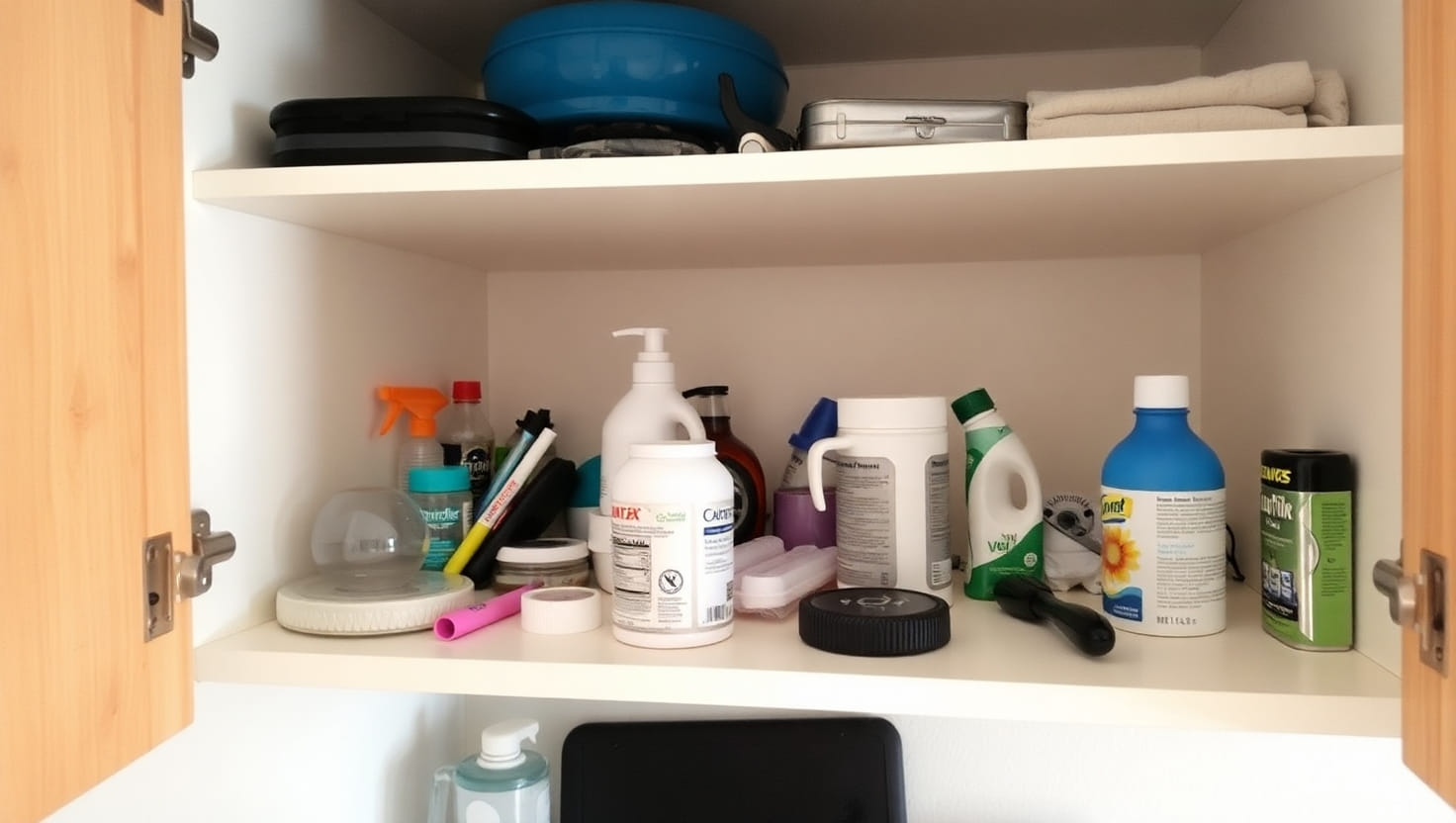
It’s also helpful to avoid storing items for imaginary versions of your life. Storage should reflect current routines, not aspirational ones. When storage aligns with reality, it’s easier to maintain.
Adjusting storage doesn’t always involve buying anything new. Often it’s about editing what’s being stored and rethinking placement. Small shifts can dramatically improve how a space functions.
When retrieval becomes easy, clutter has less reason to accumulate elsewhere.
Expect decluttering to change as your life changes
Decluttering is not a one-time event because life doesn’t stand still. Your needs, schedules, and capacities evolve, and your home reflects that. Expecting your space to stay permanently settled can lead to frustration when it inevitably shifts again.
A more sustainable view is to see decluttering as periodic recalibration. Certain seasons may require more flexibility, others more structure. What worked last year may not fit now, and that doesn’t mean you did anything wrong.
This perspective removes the pressure to get things “right” forever. You’re allowed to revisit decisions as circumstances change. An item that leaves your house today might have been necessary before. Both can be true.
It also helps to notice when clutter is signaling transition rather than neglect. During busy or uncertain times, systems loosen. Recognizing this can replace self-criticism with curiosity.
When you accept that decluttering is responsive, not final, it becomes less daunting. You’re not chasing a fixed endpoint. You’re adjusting your environment to support the life you’re currently living.
That mindset keeps the process gentle and adaptable over time.
Pay attention to the spaces between tasks, not just the tasks themselves
Clutter often builds up in the pauses between activities rather than during the activities themselves. These are the moments when items are set down “for now” because there’s no clear next step. Shoes by the door, papers on the counter, bags on chairs. None of these are problems on their own, but together they create visual and mental noise.
Noticing these transition points can be more effective than focusing on storage alone. When you see where items consistently land, you’re seeing where your routines are asking for more support. The clutter isn’t random. It’s following your movement through the day.
You don’t need to redesign your whole house to respond to this. Sometimes a small adjustment is enough. A hook where a bag naturally gets dropped. A tray where papers can pause without spreading. These are not rules, just acknowledgments of how life flows.
What matters is that the space works with you instead of requiring constant correction. When transitions are supported, clutter has fewer opportunities to accumulate unnoticed.
This approach also reduces self-blame. You’re not messy or disorganized. You’re human, moving from one thing to the next. Decluttering becomes a matter of smoothing those handoffs rather than fixing yourself.
Over time, addressing transition points can quietly transform how your home feels to move through.
Give yourself permission to keep “good enough” solutions
Many people delay decluttering because they’re waiting for the right system. The right containers, labels, or layout. In the meantime, clutter continues to press in. This often leads to the belief that nothing is worth doing until it can be done properly.

In practice, “good enough” solutions are often what make progress possible. A temporary bin, a loosely defined drawer, or a simple grouping can relieve pressure immediately, even if it’s not perfect.
Decluttering doesn’t require final answers. It requires functional ones. If something reduces friction today, it’s serving its purpose. You can always refine later, but waiting for ideal conditions keeps things frozen.
Allowing imperfection also lowers the emotional stakes. You’re not committing to a system forever. You’re testing what helps. This mindset makes it easier to let go of items because you’re not also demanding a flawless replacement structure.
It can be helpful to notice which “temporary” solutions quietly last. Those are often the ones that align best with your habits. They may not look impressive, but they work.
When you accept good enough, decluttering becomes lighter. Movement replaces hesitation, and relief arrives sooner.
Be selective about what earns visible space
Not everything in your home needs to be hidden away, but not everything deserves constant visibility either. Visible space carries a cost. It asks for attention every time you pass by. Being intentional about what lives in that space can significantly reduce mental clutter.
This doesn’t mean stripping surfaces bare. It means choosing what you want to see regularly. Items used daily, objects that bring calm, or things that anchor routines often earn their place. Everything else might be better stored elsewhere.
Clutter often happens when visibility is used as a reminder system. Items stay out because you’re afraid you’ll forget them. While understandable, this approach can backfire by creating a constant sense of unfinished business.
Instead, it can help to create fewer, more reliable reminder zones. One place where important items live temporarily, rather than many scattered cues. This concentrates attention instead of diffusing it.
Being selective with visible space is a form of boundary-setting. You’re deciding what gets to occupy your awareness. Over time, this makes rooms feel more spacious without removing everything you enjoy.
When visibility is intentional, your home starts to feel calmer without becoming sparse.
Let decluttering decisions be reversible when possible
One of the reasons decluttering feels heavy is the fear of regret. Once something leaves, it can feel final. That pressure can stall decisions, especially around items that sit in a gray area between useful and unnecessary.
Reversibility can ease this tension. When possible, treat decisions as provisional rather than permanent. Setting items aside in a donation box for a while, or storing them out of sight before letting them go, can create emotional distance without forcing immediacy.
This pause often brings clarity. Items you don’t miss reveal themselves quietly. Items you find yourself thinking about can be reconsidered without judgment. Either outcome is informative.
Decluttering doesn’t need to be decisive to be effective. Gradual separation is still separation. What matters is reducing what’s in your active space, not proving resolve.

It’s also worth remembering that replacing an item later is rarely catastrophic. The fear of needing something again is often larger than the actual cost or inconvenience.
When decisions feel safer, momentum increases. You move forward without bracing, and the process becomes steadier.
Focus on maintaining clarity, not constant tidiness
A decluttered home doesn’t require constant upkeep to look orderly. What it does require is clarity. Clarity about where things belong, how much fits comfortably, and when a space needs attention.
Tidiness tends to fade quickly if it relies on repeated effort alone. Clarity, on the other hand, supports itself. When items have obvious homes and limits, resetting a space takes less time and thought.
This is why decluttering is more impactful than frequent cleaning. Cleaning addresses surfaces. Decluttering addresses decisions. Once decisions are made, maintenance becomes lighter.
It can help to notice when a space starts to feel confusing rather than messy. Confusion often signals that boundaries have been exceeded or roles have shifted. Addressing that early prevents buildup.
Maintaining clarity doesn’t mean keeping everything perfect. It means being able to restore order without resentment or exhaustion. That’s a quieter, more sustainable standard.
When your home supports easy resets, it becomes a place you can return to, even after busy or difficult periods.
A quieter way forward, when you’re ready
If this approach to decluttering feels more realistic than what you’ve tried before, there’s a reason for that. What usually makes decluttering stick isn’t effort or discipline, but alignment with how you actually live and think. I wrote more about that shift—and how it unfolded over time—on a separate page. It’s not a method or a system, just an explanation of what finally changed for me when nothing else had held.
There’s nothing you need to do with it right away. It’s simply there when curiosity opens.